

Gear Ratio Selection and Torque-Speed Matching for Electric Transaxles: A Procurement Engineer’s Workflow
For overseas buyers specifying electric transaxles from a Chinese manufacturer such as HLM Transaxle, the single decision that most affects vehicle performance, cost, and time-to-market is the gear ratio. Too high a ratio and the machine crawls while the motor screams at its redline; too low and it stalls on the first grade. Yet ratio selection is routinely deferred to the prototype stage, where a wrong number forces a tooling change, a motor swap, or both. This article lays out a sourcing workflow that puts gear ratio selection into the procurement phase, where it belongs, and shows how to match axle, motor, and duty cycle before committing to tooling.
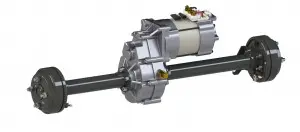
Why Ratio Decisions Belong in the Procurement Phase
A transaxle is not a commodity fastener that can be reordered at a different spec next month. The final drive ratio is cut into the gear set, the housing often carries mounting bosses tuned to that ratio’s package, and the motor interface is sized around the expected torque. Changing the ratio after tooling means new gears at minimum, and frequently a new housing and motor pairing. The cost of a late ratio correction is measured in thousands of dollars and weeks of delay, not in a price-difference line item.
The Real Cost of a Wrong Ratio
When the ratio is wrong, the symptoms appear across the whole vehicle. Top speed falls below the contract requirement, the battery drains faster than the quoted range, or the motor overheats on sustained climbs. Each symptom is usually blamed on the wrong subsystem, which sends engineering teams chasing efficiency losses in the wrong place. A structured ratio workflow prevents this by tying every number back to a measured duty cycle.
Step 1: Define the Duty Cycle Before Touching a Ratio
Procurement engineers should arrive at the supplier meeting with a duty-cycle description, not a ratio request. A duty cycle captures what the machine actually does across a shift: how far it travels, at what speeds, on what surfaces, with what payload, and how often it stops and starts. HLM Transaxle’s application engineers work from this profile to propose a ratio band rather than a single guess.
A useful duty-cycle brief contains the following elements:
- Maximum loaded vehicle weight, including batteries, payload, and operator.
- Required top speed on flat ground, and the acceptable tolerance (±5% or tighter).
- Target continuous cruise speed and the share of the shift spent at that speed.
- Worst-case grade the machine must climb, with the corresponding payload.
- Start-stop frequency, because repeated acceleration dominates motor heating.
- Wheel or tire diameter, since this converts axle rpm into ground speed.
- Operating environment temperature range and any cooling limitation.
Why Wheel Diameter Is the Hidden Variable
Many sourcing errors trace back to a wheel diameter that changed between the concept sketch and production. A 10% larger tire drops ground speed at a fixed motor rpm by 10% and raises the effective load torque the axle must deliver. Always lock the tire size in the brief and treat it as a fixed input, not an afterthought.
Step 2: Translate Vehicle Targets into Axle Torque and Speed
With the duty cycle fixed, the next step is to convert vehicle targets into two axle numbers: required output torque at the wheel and required axle output speed. The relationship is straightforward. Output speed at the axle equals ground speed divided by wheel circumference, expressed in revolutions per minute. Output torque equals the tractive force needed (to overcome rolling resistance, grade, and acceleration) multiplied by the effective wheel radius.
Working the Grade Climb Backward
The grade climb is usually the binding constraint. Climbing a 15% grade with a 1,200 kg machine requires substantially more tractive force than cruising on flat ground, and that force must be available at low axle speed. This is where torque-speed matching becomes the central calculation: the axle ratio must place the motor’s peak-torque region at the axle speed the grade demands, not at the speed the flat-ground cruise demands.
Buyers who only optimize for top speed routinely under-specify the ratio and discover the machine cannot hold a ramp. Buyers who only optimize for climb over-specify and end up with a slow, inefficient vehicle that wastes battery on every flat meter. The workflow exists to find the compromise that satisfies both.
Step 3: Match the Motor Curve to the Transaxle Ratio
A motor is defined by its torque-speed curve, and the transaxle ratio is the gearbox that maps that curve onto the wheels. The practical task is to choose a ratio such that, across the duty cycle, the motor operates inside its efficient band rather than against its limits.
Placing the Motor’s Sweet Spot
Most brushed and brushless DC motors for AGV and floor-care use deliver peak torque at low rpm and peak power at higher rpm, with efficiency peaking in a mid-range window. The ratio should position the cruise operating point inside that efficiency window. If the cruise point sits to the right of the window, the motor runs hot and draws excess current; if it sits to the left, the machine is over-geared and the top speed target is unreachable without a larger, costlier motor.
HLM Transaxle publishes motor-and-axle combination data so buyers can overlay their duty cycle on the curve before ordering. This is also where the related reading on how to match an electric transaxle with a motor becomes relevant for teams building their own motor specification.
Avoiding the Two Failure Modes
There are two classic mismatches. The first is motor over-rev at top speed, where the chosen ratio spins the motor past its safe maximum and shortens brush or bearing life. The second is chronic under-speed, where the machine never reaches contract speed because the motor hits its power limit before the ratio allows it. Both are visible on paper before a single prototype is built, which is exactly the point of doing this math in procurement.
Step 4: Validate Efficiency and Thermal Load at the Operating Point
Ratio selection is not only about whether the machine moves; it is about how much battery it consumes doing so. A ratio that places the motor just outside its efficiency window can cut usable range by double digits. For battery-powered equipment where range is a selling point, this directly affects the product’s competitiveness.
Thermal load is the companion concern. Continuous-duty applications such as floor scrubbers and AGVs run for hours without cooldown. The duty-cycle brief from Step 1 should be run through the motor’s thermal model at the proposed ratio. If the average loss exceeds the cooling capacity, the answer is rarely a bigger motor; it is often a small ratio adjustment that moves the operating point into a cooler part of the curve, or a thermal management option such as an integrated fan or finned housing.
Step 5: Build a Tolerance and Margin Policy
Even a perfectly calculated ratio degrades in the field. Tire wear reduces diameter over time, battery voltage sags under load, and component friction increases with age. A procurement spec should therefore include margin: a ratio chosen so that even at the worst-case combination of worn tires, low battery, and high temperature, the machine still meets its minimum performance contract.
A sensible policy is to nominally target the middle of the acceptable speed range and reserve the top and bottom 5% as field margin. This absorbs manufacturing variation between axles and keeps the fleet consistent across its service life. Specifying this margin up front prevents the field complaints that otherwise surface six months after delivery.
Common Sourcing Mistakes in Ratio Selection
Across EV, AGV, floor-cleaning, and machinery programs, the same avoidable errors repeat. Recognizing them shortens the supplier conversation and reduces risk.
- Requesting a ratio copied from a competitor’s machine without verifying wheel size, payload, or motor rating differs.
- Optimizing only for top speed and ignoring the grade-climb torque requirement.
- Treating the motor and axle as separate purchases and matching them after both are ordered.
- Skipping the thermal check for continuous-duty equipment on the assumption that “it will be fine.”
- Leaving tire diameter unconfirmed, then discovering a 10% speed error at first trial.
- Specifying zero margin, so normal wear pushes the machine out of contract within a season.
Working with HLM Transaxle on Custom Ratio Development
HLM Transaxle supports joint development programs where the ratio is treated as a design parameter rather than a catalog pick. For buyers with a defined duty cycle, the engineering team can propose a ratio band, supply motor-curve overlays, and in many cases provide a bench-validated sample before full tooling. This de-risks the program because the ratio is proven against the actual load profile rather than estimated from a similar product.
The company’s range spans electric transaxles, drive axles, and motor assemblies for EV, AGV, floor-cleaning machines, golf carts, and general machinery, which means a single supplier relationship can cover multiple product lines with consistent engineering support. A practical approach is to start with one high-volume SKU, validate the ratio workflow end to end, then replicate the method across the rest of the catalog.
For teams still defining their electrical architecture, the guide on what voltage electric transaxle to choose is a useful companion read, because voltage and ratio are solved together, not independently. Likewise, the electric transaxle technical specifications guide helps standardize the brief format used in Step 1.
Tip: Send your supplier a one-page duty-cycle brief with locked tire diameter and grade requirement before requesting any ratio quote, because a ratio proposed without those inputs is only a guess.
FAQ
How do I know if my current transaxle ratio is wrong?
The clearest signs are a top speed that misses contract by more than 5%, a motor that runs hot during normal cruise, or an inability to hold a specified grade with full payload. Any one of these points to a ratio that was either copied from an incompatible reference or calculated without a duty-cycle brief.
Can one gear ratio satisfy both high top speed and strong climbing?
Only within the margin your motor’s power and torque envelope allow. A single fixed ratio is always a compromise between cruise efficiency and climb capability. If the application demands both extremes, consider a two-speed transaxle or a higher-power motor sized so the compromise ratio stays inside both limits.
Does tire wear really change performance enough to matter?
Yes. A worn tire can be 8 to 12% smaller in diameter than new, which raises axle rpm and lowers available tractive torque at the wheel. If your ratio left no margin, the machine will fall out of its speed and climb contract well before the tires are legally worn out.
Should I buy the motor and transaxle from the same supplier?
Where possible, yes. Matching a motor to an axle after both are purchased invites the mismatch failure modes described above. A supplier that delivers a validated motor-and-axle combination removes the interface risk and usually shortens the development timeline.
How much margin should I build into the ratio specification?
A practical rule is to target the middle of the acceptable speed band and reserve roughly 5% at each end for field variation from tire wear, battery sag, and component aging. This keeps the fleet consistent across its service life without over-speccing the motor.
What information does HLM Transaxle need to propose a ratio?
The duty-cycle brief from Step 1: loaded weight, required top and cruise speeds with tolerances, worst-case grade and payload, start-stop frequency, locked wheel diameter, and the operating temperature range. With those inputs, the engineering team can return a ratio band and motor-curve validation.
Related Pages
- Electric Transaxle Technical Specifications Guide
- What Voltage Electric Transaxle Should You Choose
- How to Match Electric Transaxle with Motor
- Electric Transaxle vs Gearbox
Post time: Sep-14-2026