Electric Transaxle vs Gearbox: A Complete Guide for Industrial and Mobility Applications
When sourcing power transmission components for
electric vehicles, material handling equipment, cleaning machines, mobility devices and industrial trolleys, choosing between an electric transaxle and a standalone gearbox is one of the most critical decisions. The two solutions share core functions of torque conversion and speed regulation, yet they differ drastically in structure, performance, installation, maintenance and applicable scenarios. For equipment manufacturers, fleet operators and component purchasers, understanding their strengths, weaknesses and ideal use cases will help you cut procurement costs, improve equipment reliability and optimize long-term operational efficiency. This guide breaks down every key aspect to help you make a well-informed choice.
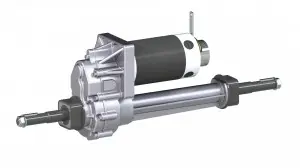
What Are Electric Transaxle and Traditional Gearbox? Core Definitions & Working Principles
To compare the two solutions fairly, we first clarify their basic structures and how they deliver power in electric systems.
Electric Transaxle
An electric transaxle is an all-in-one integrated drive unit that combines a DC electric motor, reduction gear set, differential mechanism and drive axle into a single compact assembly. It is designed specifically for low-to-medium speed electric mobile equipment. The motor directly connects to the internal gear system, which reduces the high rotational speed of the motor and amplifies torque, then distributes power evenly to the driving wheels via the built-in differential.
The biggest feature of this design is integration. All core transmission parts are pre-assembled, calibrated and sealed in one housing. Power transmission follows a straight path from motor to wheels without extra connecting parts. Most electric transaxles on the market support common DC voltage specifications including 24V, and match power ratings ranging from 300W up to 2200W, fully covering light-duty to medium-load mobile equipment needs.
Traditional Gearbox
A gearbox, also known as a speed reducer, is a standalone mechanical component. It only contains gear trains, bearings, shafts and a housing, with no built-in motor or axle structure. It works as an independent intermediate part: users need to pair it with a separate electric motor, then connect the output end to axles, chains, belts or other driving structures to complete power transmission.
Its core function is purely speed reduction and torque boost. It relies on external power sources to operate, and the overall power system is composed of multiple discrete parts assembled on-site. Gearboxes come in diverse types such as worm gear, helical gear and planetary gear, with flexible specifications to adapt to various industrial transmission demands.
Head-to-Head Comparison: Key Performance Factors
We evaluate the two products from seven core dimensions that buyers care about most: structure and installation, power transmission efficiency, torque and speed performance, durability and maintenance, space occupation, cost and noise performance.
1. Structure & Installation Complexity
Electric Transaxle
Thanks to the integrated design, the overall structure is highly streamlined. Buyers receive a complete finished unit, with unified interfaces for mounting and wiring. Installation only requires fixing the transaxle to the equipment frame, connecting power lines and matching wheel hubs. There is no need to align motors, gearboxes and axles separately.
The integrated structure eliminates the risk of misalignment between discrete components, greatly lowering technical requirements for assembly teams. It is friendly to small equipment factories and after-sales maintenance teams with limited professional assembly capabilities.
Traditional Gearbox
The gearbox is a separate part, so the entire power system requires three independent modules: motor, gearbox and drive mechanism. During installation, workers need to precisely adjust the coaxiality between the motor output shaft and the gearbox input shaft, and then connect the gearbox output end to axles or transmission accessories.
The assembly process involves multiple steps of debugging and fixation. Improper alignment will cause abnormal wear, vibration and power loss. This means higher requirements for assembly skills and longer on-site installation time. For mass production of equipment, it will also reduce overall production efficiency.
2. Power Transmission Efficiency
Transmission efficiency directly affects equipment power consumption and battery life, which is especially important for battery-powered electric devices.
Electric transaxles adopt an integrated closed structure. The internal gear matching is precisely factory-calibrated, with short power transmission paths and fewer intermediate connection links. Energy loss during power delivery is kept to a minimum. In daily low-speed operation scenarios, its comprehensive transmission efficiency remains stable at a high level. For battery-powered equipment, higher efficiency translates to longer single-charge working hours.
Traditional gearbox systems have more connecting links between discrete components. Each connection point will produce slight energy loss. In addition, on-site assembly errors may further increase friction loss. Under the same motor power and load conditions, the overall transmission efficiency of a split gearbox system is slightly lower than that of an integrated electric transaxle. The gap becomes more obvious during long-duration continuous operation.
3. Torque & Speed Adaptability
Both products can realize speed reduction and torque increase, but their adaptability to working conditions varies.
Electric transaxles are optimized for low-speed, high-torque and constant-speed operating scenarios. Factory-matched gear ratios are fixed, focusing on meeting the travel power demand of mobile equipment such as trolleys, cleaning machines, small electric tractors and three-wheel mobility vehicles. It can output stable torque at startup, adapting to frequent start-stop and flat-ground travel. However, due to fixed gear ratios, it is not suitable for scenarios that require frequent switching between high and low speeds or extreme high-load climbing.
Traditional gearboxes support flexible gear ratio matching. Users can select gearboxes with different reduction ratios according to actual needs, and even match multi-stage gear sets to obtain ultra-high torque or adjust to higher operating speeds. When paired with different motors, it can cope with complex working conditions such as heavy-load climbing, variable-speed operation and industrial fixed-position transmission. Its parameter flexibility far exceeds that of integrated transaxles.
4. Durability, Failure Rate & Maintenance
Durability and post-maintenance costs are core indicators for long-term equipment operation, especially for commercial equipment that runs continuously.
Electric Transaxle
All internal parts are sealed inside the integral housing, which can effectively block dust, water splashes and debris, and adapt to harsh working environments such as workshops, warehouses and outdoor sites. The number of external connecting parts is small, so the failure points are concentrated inside the unit.
In routine maintenance, users only need to regularly check the power lines and mounting fasteners, and replace internal lubricating oil according to the cycle. The overall failure rate is low. The downside is that if internal gears or bearings are damaged, the disassembly and repair process is relatively complicated. For most users, replacing the entire transaxle is more convenient than partial maintenance.
Traditional Gearbox
The split structure has more exposed connecting parts, which are vulnerable to dust, collision and moisture in complex environments, leading to loose connections or component wear. Each discrete module (motor, gearbox, connector) is an independent failure point, so the overall system failure rate is relatively higher.
Its advantage lies in convenient partial maintenance. Once a certain part fails, you only need to replace the faulty component instead of changing the entire power system. For large-scale industrial equipment with complete maintenance teams, this modular maintenance method can reduce spare parts costs.
5. Space Layout & Weight
For compact mobile equipment, the size and weight of power components will directly affect the equipment’s structural design and operating flexibility.
The electric transaxle integrates multiple parts into one. Although the single unit has a certain volume, it saves the installation space required for separate placement of motors, connecting brackets and transmission accessories. The overall layout is neat and compact, which is very suitable for small and medium-sized mobile equipment with limited internal space. The integrated weight is evenly distributed, helping the equipment maintain stable driving.
A separate gearbox plus a separate motor requires independent installation space for two parts, as well as brackets and connecting accessories, occupying more overall space. The scattered weight also puts forward higher requirements for the equipment frame design. It is more suitable for large industrial equipment with sufficient layout space, rather than compact light mobile devices.
6. Comprehensive Cost (Procurement + Assembly + Operation)
Cost is a key consideration for bulk purchasers. We analyze the total cost from three stages: initial procurement, assembly and later operation.
On the initial procurement side, a single electric transaxle has a higher unit price than a single gearbox. But it is a complete set, with no need to purchase additional connecting brackets, couplings and other accessories. The traditional gearbox is low in individual price, but supporting motors, connecting parts and fixing accessories need additional procurement, and the total material cost of the complete system is not low.
In terms of assembly cost, the electric transaxle saves a lot of labor and time costs due to simple installation. The split gearbox system requires prolonged assembly and debugging, increasing labor costs in mass production.
In long-term operation, the electric transaxle has a low failure rate and stable performance, with fewer downtime losses and maintenance labor costs. The split gearbox system has many failure points, and the cumulative cost of repeated maintenance and part replacement in the later period will gradually increase.
7. Noise & Vibration Performance
Commercial equipment and public mobility devices have strict requirements for operating noise.
The internal gears of electric transaxles are precisely matched in the factory, and the integral housing has a certain sound insulation effect. During operation, the vibration between components is small, and the overall noise is low, which is suitable for shopping mall trolleys, indoor cleaning machines, residential mobility vehicles and other noise-sensitive scenarios.
Due to errors in on-site assembly and multiple connecting gaps between discrete parts, the gearbox system is prone to resonance and additional vibration during operation, resulting in relatively louder running noise. When the assembly precision is insufficient, the noise problem will become more prominent.
Ideal Application Scenarios: Which One Should You Choose?
Combined with the performance characteristics of the two products, we sort out their most suitable application fields to help you quickly match products according to equipment types.
Choose Electric Transaxle for These Scenarios
Electric transaxles are the preferred solution for light and medium-duty electric mobile equipment, especially for buyers who pursue convenient installation, stable operation and low later maintenance.
- Cleaning and sanitation equipment: 24V DC drive floor washers, sweepers and small cleaning vehicles. Multiple power specifications from 400W to 1500W can meet the needs of different sizes of cleaning machines.
- Material handling trolleys: Warehouse handling trolleys, supermarket cargo trolleys and airport luggage trolleys. The integrated structure is compact and easy to deploy in narrow spaces.
- Small agricultural and garden equipment: Low-power electric tractors and garden transport vehicles. It adapts to outdoor dusty environments and has strong stability.
- Mobility vehicles: Three-wheeled mobility vehicles and stroller-type electric vehicles. Low noise and stable torque ensure comfortable and safe travel.
- Batch-manufactured light electric equipment: Manufacturers that need mass assembly. Simple installation can significantly improve production efficiency.
Choose Traditional Gearbox for These Scenarios
Traditional gearboxes are more suitable for large industrial equipment, equipment with complex working conditions and customized transmission systems, and are favored by users who need flexible parameter matching and modular maintenance.
- Heavy-duty industrial transmission equipment: Industrial conveyor lines, large lifting machinery and fixed production equipment. Various reduction ratios are matched to achieve high torque output.
- Equipment with variable speed and complex working conditions: Machinery that needs frequent switching between high speed and low speed, and frequent heavy-load climbing. The flexible gear ratio of the gearbox can adapt to diverse working demands.
- Large engineering vehicles and heavy transport equipment: Large electric transport vehicles with high load requirements. Multi-stage gearboxes are matched to achieve ultra-high torque.
- Equipment requiring personalized customization: Special industrial equipment with non-standard installation sizes and power demands. Standalone gearboxes can be freely combined with different motors to complete customized design.
Common Misconceptions to Avoid When Purchasing
After comparing performance and scenarios, we summarize several common misconceptions in procurement to help you avoid pitfalls:
- “The lower the price, the better”: For light mobile equipment, simply choosing a low-priced split gearbox system will lead to increased later failure rates and maintenance costs. The low initial investment will turn into higher long-term losses.
- “Integrated transaxles are not durable”: Regular qualified electric transaxles adopt an all-sealed structure, with better dustproof and waterproof performance than split systems. The core problem of durability lies in product quality rather than structural form.
- “Gearboxes can replace transaxles in all scenarios”: In compact small equipment, the split gearbox system will cause crowded layout, increased vibration and loud noise, which cannot replace the advantages of integrated transaxles.
- “Transaxles cannot adapt to high power”: Modern electric transaxles have covered power segments up to 2200W, which can meet the power demands of most medium-load mobile equipment. There is no need to blindly pursue split gearboxes for medium power.
Final Verdict: Quick Selection Guide
- Pick an electric transaxle if you produce or operate light-to-medium electric mobile equipment, prioritize easy installation, low failure rate, low noise and low daily maintenance, and your equipment works mainly at a fixed low speed on flat ground. It is the most cost-effective choice for most standard electric trolleys, cleaning machines and mobility vehicles.
- Pick a traditional standalone gearbox if you need flexible gear ratio adjustment, customized power matching, or your equipment faces complex working conditions such as heavy load, variable speed and steep climbing. It is the preferred solution for large industrial equipment and non-standard customized machinery.
In the electric drive industry, there is no absolute better product, only the most suitable one. Clarify your equipment’s load, operating environment, space constraints and later maintenance capabilities, and you can accurately select the right power transmission solution to maximize equipment operational efficiency and control comprehensive costs.
Post time: Jun-17-2026