

Why IP Rating Is the Lifeline of Outdoor Electric Transaxles
A drivetrain that fails in the field rarely fails because the gears are too weak. It fails because water, dust, or salt crept past a seal and corroded a bearing, shorted a connector, or swelled a motor winding. For a waterproof transaxle deployed on a street sweeper, a dock AGV, or a marine thruster, the IP code on the datasheet is not a marketing footnote. It is the single most reliable predictor of whether the unit survives its first wet season.
OEMs building low-speed EVs, floor cleaning machines, and garden equipment too often treat the IP rating as a box to tick at the end of design. By then the housing geometry, cable entry, and axle tube routing are fixed, and retrofitting protection costs a tooling change. Specifying ingress protection upfront, against the actual duty cycle, is what separates a drivetrain with a three-year service life from one that seizes in eight months.
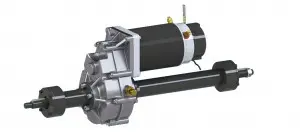
Decoding the IP Code: First Digit and Second Digit
The IP mark is followed by two numerals. The first defines solid-particle protection, the second defines liquid protection. A third letter such as K appears on higher ratings to denote resistance to high-pressure, high-temperature wash-down jets.
The first digit runs 0 to 6. A rating of 5 means limited dust ingress that does not impair operation. A 6 means complete dust tightness. For an outdoor drive axle working in abrasive environments such as construction sites or fertilizer handling, the difference between IP5X and IP6X decides whether silica grit reaches the gear mesh.
The second digit runs 0 to 9K. It climbs from vertical dripping through spraying, jetting, immersion, and finally pressurized hot-water cleaning. Understanding both digits independently prevents the common mistake of specifying IP67 for a machine that is actually pressure-washed daily, where IP69K is the correct call.
IP54, IP65, IP67, IP68, and IP69K in Practice
IP54 resists splashing water and limited dust. It suits indoor AGVs and dry warehouse tows where condensation is the only threat. IP65 blocks low-pressure jets from any direction and is the baseline for outdoor mobile equipment exposed to rain.
IP67 means temporary immersion to one meter for thirty minutes. IP68 extends immersion depth and duration by agreement, which matters for submersible or semi-submerged duty. IP69K withstands close-range, high-pressure, high-temperature steam cleaning and is mandatory for food-grade and heavy sanitary cleaning equipment.
Choosing the highest number by instinct is wasteful. IP69K housings demand tighter tolerances, more expensive seals, and heavier castings. A garden tractor that never sees a pressure washer does not need it. Match the rating to the cleaning and exposure regime, not to a fear of water.
Matching IP Ratings to Real Applications
Floor scrubbers and ride-on cleaners spend their lives in puddles and recover dirty water. They need at least IP67 on the axle and motor junction, because submerged operation is routine during a cleaning pass. Street sweepers collecting wet leaves and slush sit comfortably at IP65 on the transaxle body but benefit from IP67 at the cable gland.
Outdoor AGVs moving containers across open yards face rain, mud, and temperature swings. IP67 is the entry point, with IP68 preferred where the unit may ford flooded ramps. Beach buggies and dune vehicles demand IP67 against sand ingestion and occasional wave splash. Marine electric thrusters and fishing-boat propulsion sit at IP68, often with additional encapsulation of the motor stator.
The pattern is consistent: define the worst credible exposure, then rate for one level above it. That margin absorbs the gap between laboratory certification and a real Thursday afternoon storm.
Sealing Architecture: Oil Seals, O-Rings, and Labyrinth Design
A credible marine electric drivetrain starts with the shaft exit. A single lip seal is not enough. Dual-lip skeleton oil seals backed by a spring-loaded garter retain grease and block water at the axle tube ends. Behind them, static joints use nitrile or fluorocarbon O-rings sized to the groove, not stretched over threads.
Labyrinth seals add a non-contact path that traps water and grit before it reaches the contact seal. In a wheel-motor transaxle, a combination of labyrinth and lip seal at the hub dramatically extends service life because the primary seal never sees the full force of a pressure wash. Housing parting lines must be machined flat and gasketed; a warped flange is a permanent leak path no O-ring can fully compensate for.
Breather Valves and VPI Motor Impregnation
Sealed housings breathe. As temperature cycles, internal air expands and contracts, pulling moisture inward through any imperfect seal. A waterproof breather valve with a Gore-Tex membrane equalizes pressure while blocking water droplets and dust. Without it, the transaxle effectively pumps water in every cool-down cycle.
The motor winding needs its own defense. Vacuum pressure impregnation, or VPI, forces insulating varnish into every void of the stator, sealing copper from humidity. A VPI-treated motor tolerates condensation that would corrode a standard dip-impregnated winding within a season. For outdoor duty, VPI should be treated as standard, not optional.
Cable entries are the other weak point. IP67-rated circular connectors with molded grommets replace field-spliced joints, which are the leading cause of water-induced controller faults on cleaning equipment.
Corrosion Protection: Coatings, Plating, and Salt Spray Testing
Water is only half the threat. Dissolved salts and road de-icer turn a damp environment into an electrochemical cell that eats aluminum and steel. Surface treatment is what keeps a IP67 IP69K transaxle alive in coastal or winter-road service.
Electrophoretic primer, or e-coat, gives uniform coverage inside channels a spray gun cannot reach. Zinc plating and zinc-nickel plating protect fasteners and brackets. Dacromet, a water-based zinc-aluminum flake coating, delivers high salt resistance without the hydrogen-embrittlement risk of plating on hardened parts.
Validate the stack with neutral salt spray testing. A 96-hour result is entry level for indoor-adjacent equipment. Outdoor and marine units should target 240 hours, with 500 hours reserved for fishing, dock, and coastal deployments where failure is not an option.
Environmental Testing and MTBF Under IP67 Conditions
Ingress protection is certified in a lab, but the field is harsher. A transaxle rated IP67 that is thermally cycled, vibration-loaded, and washed weekly will see its effective MTBF decline compared to a benign indoor duty. The decline is predictable and must be designed for.
Combine the IP test with temperature cycling from -40°C to +85°C, because thermal shock is what cracks seal seats and relaxes O-rings. A unit that holds IP67 at twenty degrees may weep at minus thirty after fifty cycles. Request the combined environmental test report, not the standalone IP certificate, before qualifying a supplier.
Document the derating. If the nominal MTBF is 20,000 hours in dry service, plan for roughly 12,000 to 15,000 hours in continuously wet outdoor duty, and size your spare-parts and maintenance budget accordingly.
Maintenance Intervals for Outdoor Drive Axles
Even a well-sealed axle needs a schedule. For IP65 street equipment, inspect seals and breather membranes every 500 operating hours and replace torn gaiters immediately. For IP67 cleaning and AGV fleets, a 250-hour visual check of cable glands and hub seals catches most failures before they strand a machine.
Marine and fishing-boat drivetrains should have the breather valve and shaft seals serviced every 200 hours, with a full freshwater rinse after each salt exposure. Keep a spare seal kit on hand; the cost of one kit is a fraction of a recovered and rebuilt axle.
Field Cases: Scrubbers, Dock AGVs, and Fishing Boats
A commercial scrubber OEM moved from IP65 to IP67 on the wheel-motor transaxle after field returns showed connector corrosion. Returns dropped by roughly forty percent in the first year, and the added cost per unit was under three percent of bill of materials.
A port operator running AGVs across flooded ramp approaches specified IP68 with Dacromet fasteners and 500-hour salt spray validation. After eighteen months of coastal service, bearing replacements stayed within the planned maintenance window with no water-ingress related failures.
A fishing-boat electric thruster used a VPI-impregnated motor, IP68 housing, and a Gore-Tex breather. Despite frequent saltwater immersion, the unit completed two full seasons before its first scheduled seal service, confirming that the right rating plus the right internals beats a higher number alone.
FAQ
What IP rating do I need for a floor scrubber transaxle?
Plan for IP67 at minimum on the axle and motor junction, because the unit operates in standing water during every cleaning pass. Cable glands and connectors should also be IP67.
Is IP69K better than IP67 for outdoor AGVs?
Only if the machines are pressure-washed with hot water. For rain and puddle exposure, IP67 or IP68 is sufficient and cheaper. Specifying IP69K for a non-washed AGV adds cost without benefit.
Can a sealed transaxle still take in water?
Yes, through thermal breathing if no breather valve is fitted, or through a damaged seal after impact. That is why a Gore-Tex breather and a regular seal inspection matter as much as the rated number.
How does salt spray testing relate to IP rating?
IP rating covers ingress of water and dust. Salt spray testing covers corrosion resistance of surfaces and fasteners. Both are required for marine and winter-road equipment, and one does not substitute for the other.
Does VPI motor impregnation improve waterproofing?
It protects the stator windings from humidity and condensation, which is a different mechanism from housing seals. Together they give the motor a far longer life in wet duty than seals alone.
What maintenance interval is realistic outdoors?
For wet outdoor and marine duty, inspect seals, breather, and cable glands every 200 to 250 operating hours. Indoor-adjacent IP65 equipment can extend to 500 hours.
Should I always choose the highest IP number available?
No. Over-specifying adds weight, cost, and sealing complexity. Rate for the worst credible exposure plus one level, then invest the budget in corrosion protection and testing instead.
Related Pages
- Electric Transaxle Technical Specifications Guide
- What Voltage Electric Transaxle Should You Choose
- Electric Transaxle vs Gearbox
- How to Match Electric Transaxle with Motor
Tip: Always request the combined IP plus thermal-cycle test report, because a standalone IP certificate does not prove the seals survive real outdoor temperature swings.
Post time: Sep-11-2026