

For most original equipment manufacturers, the conversation about an electric transaxle ends at the purchase order: price, delivery, and technical fit are validated, tooling is committed, and production begins. Yet the component that quietly decides whether a customer renews a service contract is the one that fails three years later at 2 a.m. in a warehouse in another time zone. A spare parts strategy is not an afterthought to sourcing; for EV, AGV, floor-cleaning, and machinery builders, it is a core part of the total cost of ownership and a direct driver of after-sales margin.
This guide walks procurement engineers, service managers, and supply-chain leads through the practical work of planning spare electric transaxle parts before a product reaches the field. It covers which components to stock, how to size inventory against failure rates and lead times, how to structure supplier agreements so spare parts do not become a recurring emergency, and how to avoid the most common mistakes that turn a manageable warranty claim into a fleet-wide recall.
Why Spare Axle Planning Belongs in the Sourcing Phase
The cheapest moment to decide a spare part exists is during component qualification, not during the first field failure. Once a transaxle design is frozen and tooling is paid for, the supplier’s production schedule is optimized for your build rate, not for your service network. Reordering fifty replacement units six months after launch often means jumping the queue behind other OEMs, with lead times that can stretch past the patience of your end customer.
When the axle is integrated into a golf cart, an automated guided vehicle, or a ride-on floor scrubber, the failure of a single sealed bearing or a controller harness can ground the entire machine. For an AGV fleet operator, one non-running vehicle may not shut a line, but ten of them will. The procurement decision that protects that operator is made long before the failure, in the service-parts section of the original supplier qualification.
The Real Cost of a Missing Spare
A missing spare axle part is rarely just the price of the part. It is the technician’s second visit, the expedited freight, the loaner unit, the goodwill credit, and sometimes the lost renewal. For machinery builders selling into factories, unplanned downtime is billed by the hour and the customer remembers it. Building the service-parts plan into the sourcing decision converts an unknown future liability into a line item you can forecast.
Which Transaxle Components Actually Need Spare Coverage
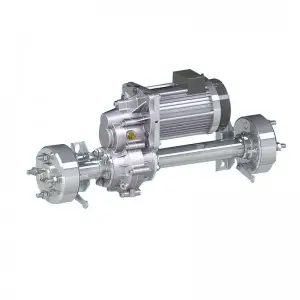
Not every part inside an electric transaxle deserves a stock-keeping unit. A sealed transaxle is engineered as a unitized assembly, and in many cases the most cost-effective service path is a whole-unit swap rather than field teardown. The planning work is deciding, per model, where the swap boundary sits.
- Complete transaxle assemblies — the fastest field fix, highest unit cost, lowest technical risk. Stock these for the highest-volume models and for any application where technician time is expensive.
- Motor and controller sub-assemblies — separable on many designs, allowing a failed drive motor to be replaced without scrapping the gear set and housing.
- Seals, bearings, and gaskets — low-cost wear items that, if stocked, extend the life of a returned core and support a refurbishment loop.
- Wheel-end and brake interface hardware — mounting bolts, hubs, and brake caliper brackets that are cheap but, when missing, can stop an entire service job.
- Harnesses and connectors — the parts most exposed to corrosion and physical damage, and the ones least likely to be standardized across your product range.
For most B2B buyers, the right shape is a small number of complete assemblies held centrally, plus a broader set of low-cost sub-components held at regional depots. The exact mix depends on your failure-mode data, which you should start collecting from day one of field deployment.
Sizing Inventory Against Failure Rate and Lead Time
Spare-parts inventory is a mathematics problem dressed up as a panic. The variables are knowable: installed base, expected annual failure rate per component, supplier lead time, and your target service level. The mistake most teams make is estimating failure rate from the design’s reliability prediction rather than from early field returns, which are almost always worse.
Start With a Conservative First-Year Estimate
For a new transaxle model with no field history, plan spares against the worst of your internal bench-test yields and your supplier’s first-production defect rate, not the datasheet MTBF. A practical rule used by floor-care and AGV OEMs is to hold enough complete assemblies to cover roughly two to three percent of the first year’s installed base, then adjust monthly as returns data arrives. This buffer absorbs the unknown without tying up capital in hundreds of idle units.
Lead Time Drives the Reorder Point
If your supplier’s replacement lead time is twelve weeks and your service-level target is next-business-day dispatch for critical models, your reorder point must cover the full replenishment window plus a safety margin. A reorder point set too low is the single most common cause of stockouts in after-sales networks, because procurement teams size it to normal demand and forget the replenishment clock.
Beyond the math, build a simple tracking table by model and component, updated monthly, that records units in the field, units returned, root cause, and days to restock. Within two quarters this turns guesswork into a defensible procurement plan you can show to finance.
Structuring Supplier Agreements for Spare Continuity
The difference between a spare-parts headache and a spare-parts program is usually written into the supply contract before production starts. A transaxle is a long-life component; the model you buy in 2026 will still be in service in 2033, and your supplier’s product roadmap may have moved on by then. Protecting after-sales means negotiating for the boring clauses nobody celebrates at kickoff.
Lifecycle and Last-Time-Buy Commitments
Negotiate a written commitment that the transaxle, and its serviceable sub-components, will remain available for a defined period after you stop buying production volumes — commonly seven to ten years for industrial and mobility equipment. Where the supplier plans to discontinue a part, require a last-time-buy notification window of at least twelve months so you can place a final stocking order. Without this clause, a supplier’s quiet component redesign can strand your entire service network.
Price Protection and Core Return Terms
Spare parts are often priced higher than production volumes, and that is acceptable only if it is predictable. Lock a spare-parts price formula for the support horizon, and define the terms for returned cores: who pays freight, what condition is acceptable, and whether a refurbished unit can re-enter your stock. A clear core-return process lets you recover value from failed assemblies instead of treating every return as scrap.
Documentation and Identification
Insist on permanent, readable part numbering on the assembly and on every stocked sub-component, plus revision-controlled exploded drawings and a bill of materials you can reference years later. When a technician in another country opens a unit, the difference between a ten-minute fix and a scrapped axle is often whether the seal they need has a number they can actually order.
Engineering teams evaluating a new drive should also review the broader Electric Transaxle Technical Specifications Guide to confirm which parameters matter most for serviceability, and the piece on How to Match Electric Transaxle with Motor helps confirm that the motor and axle remain a supported pair across the product’s life.
Avoiding the Common Spare-Parts Mistakes
Several errors recur across EV, AGV, and floor-care programs, and most are predictable enough to design out during sourcing.
- Stocking by gut feel — holding spares because a part “seems important” instead of because failure data supports it. This ties up capital and still leaves gaps where failures actually happen.
- Ignoring revision drift — a transaxle superseded by a new revision may look interchangeable but changes the mounting or the harness. Track revisions per serial range so the right spare reaches the right machine.
- Centralizing everything — holding all spares at one warehouse saves on overhead but destroys your service-level promise when a regional depot waits two weeks for international freight.
- Treating the supplier as a spot market — calling for quotes only after a failure means paying premium prices and accepting whatever lead time is offered. Spare continuity is a contractual right, not a favor.
None of these are engineering failures. They are planning failures, and they are far cheaper to prevent in the sourcing phase than to repair in the field.
Tip: Negotiate spare-parts availability, price protection, and last-time-buy terms into the original supply agreement before production tooling is committed, because a supplier’s roadmap change after launch can strand your entire service network with no recourse.
Turning Spares Into After-Sales Margin
A well-run spare-parts program is not only a cost center protecting uptime; for many OEMs it is a quiet profit line. Service parts carry healthy margins, and a customer who can get a same-week replacement is a customer who buys the next machine from you. For AGV and floor-care fleets especially, the quality of after-sales support is frequently the deciding factor in a repeat purchase, ahead of the original unit price.
The strategic move is to treat the after-sales network as a product in its own right, with its own specifications and service-level targets. When procurement, service, and engineering agree on those targets before launch, the transaxle you source becomes the reason a customer stays, not the reason they file a complaint.
FAQ
How many spare transaxles should we hold for a new model launch?
For a first production year with no field history, a practical starting point is complete assemblies covering two to three percent of the installed base for your highest-volume and most service-critical models, then adjust monthly against actual return data. Pair this with a broader set of low-cost sub-components at regional depots so common wear items do not require a full-unit dispatch.
Should we stock complete axles or repair in the field?
It depends on technician cost and downtime penalty. Whole-unit swaps are fastest and lowest-risk for critical applications such as AGV fleets and industrial machinery, while field-replaceable seals, bearings, and harnesses make sense where technician time is cheap and the machine is easy to access. Most B2B programs use a hybrid: assemblies centrally, sub-components regionally.
What spare-parts clauses must be in the supplier contract?
At minimum, secure a defined post-production availability period, a last-time-buy notification window of at least twelve months, a spare-parts price-protection formula, and clear core-return and documentation terms. These clauses protect your service network when the supplier’s own product roadmap moves on.
How do we handle transaxle revision changes in spares?
Track part revisions against serial-number ranges from the first unit shipped, and require the supplier to flag any change that affects interchangeability of serviceable sub-components. Store spares by revision and train depot staff to match the spare to the machine’s serial range so a “compatible” part does not create a second failure.
Can a spare-parts program actually improve our margins?
Yes. Service parts typically carry stronger margins than production volumes, and reliable same-week support directly influences repeat purchases in fleet and industrial markets. Treating after-sales as a defined product with service-level targets turns a defensive cost into a measurable commercial advantage.
Who owns the spare-parts plan inside our organization?
Ownership should sit with a cross-functional owner from procurement, service, and engineering rather than a single department. Procurement secures terms, service sets stock levels and lead-time targets, and engineering validates interchangeability and documentation — together they keep the plan aligned with both the field and the supplier.
Related Pages
- Electric Transaxle Technical Specifications Guide
- What Voltage Electric Transaxle Should You Choose
- Electric Transaxle vs Gearbox
- How to Match Electric Transaxle with Motor
HLM Transaxle supplies electric transaxles, drive axles, and motor assemblies for EV, AGV, floor-cleaning, golf-cart, and machinery applications, with engineering support for sourcing, integration, and after-sales planning. Explore the technical resources above or contact the team to discuss a spare-parts strategy matched to your product lifecycle.
Post time: Sep-16-2026