

Electric Transaxle Price Comparison: China vs USA – Full Cost Breakdown for Buyers
When sourcing electric transaxles for industrial vehicles, AGVs, utility carts, or light EVs, price and total cost of ownership (TCO) often become the deciding factors. China and the USA are two major supply regions with distinct pricing structures, production scales, and quality positioning. This guide compares electric transaxle prices between China and the USA, breaks down cost drivers, and helps you choose the right supply option for your business.
Table of Contents
- What Is an Electric Transaxle & Why Price Matters
- Core Price Factors for Electric Transaxles
- China vs USA: Electric Transaxle Price Comparison Table
- Key Cost Differences Between Chinese & US Manufacturers
- Quality, Lead Time & After-Sales Impacts on Total Cost
- How to Choose Between Chinese & US Electric Transaxle Suppliers
- Final Buying Tips for Global Buyers
What Is an Electric Transaxle & Why Price Matters
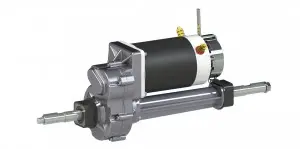
An electric transaxle integrates an electric motor, gearbox, and differential into one compact unit. It is widely used in electric trolleys, sweepers, golf carts, agricultural machinery, and industrial mobility equipment.
For buyers, unit price directly affects project budgets, while hidden costs—including logistics, tariffs, quality risks, lead time, and after-sales—can change overall profitability. Understanding real price gaps between China and the USA helps you avoid overpaying or choosing low-quality solutions that raise long-term costs.
Core Price Factors for Electric Transaxles
Multiple elements shape the final price of electric transaxles in both markets:
- Power rating: 300W, 500W, 800W, 1000W, 2200W and above
- Voltage: 24V, 36V, 48V standard systems
- Construction: cast housing, stamped steel, integrated or separate design
- Motor type: brushed DC, brushless DC, permanent magnet design
- Certifications: CE, FCC, ISO, OEM-specific standards
- Order volume: mass production vs small-batch customization
- Logistics & tariffs: sea freight, import duties, warehousing
- Labor & overhead: manufacturing wages, factory rent, R&D allocation
These factors create consistent price differences between Chinese and US-made electric transaxles.
China vs USA: Electric Transaxle Price Comparison Table
Prices shown are FOB or factory-gate estimates in USD for standard models, based on 2026 global industrial component market data. Actual prices vary by quantity, configuration, and supplier.
| Power & Voltage | China Typical Price | USA Typical Price | Price Difference |
|---|---|---|---|
| 24V 300W–500W | $70 – $110 | $160 – $240 | 45%–55% lower in China |
| 24V 800W–1000W | $90 – $150 | $200 – $300 | 45%–55% lower in China |
| 24V 1500W–2200W | $140 – $220 | $280 – $420 | 40%–50% lower in China |
| Custom integrated unit | $180 – $300 | $350 – $600 | 40%–50% lower in China |
Notes:
- US prices include higher domestic labor, material, and operational costs.
- Chinese prices reflect large-scale manufacturing, complete supply chains, and economies of scale.
- Import fees, shipping, and customs are not included in the above figures.
Key Cost Differences Between Chinese & US Manufacturers
1. Manufacturing & Labor Cost
Chinese factories benefit from mature industrial chains for motors, gears, housings, and electronic parts. High automation and large-batch production lower per-unit costs significantly. US manufacturers face higher wages, stricter compliance, and smaller production runs, leading to naturally higher prices.
2. Supply Chain Maturity
China has a dense, vertically integrated supply chain for electric drive components. Many producers control casting, machining, motor winding, and assembly in-house or within a short radius. US producers often rely on imported parts or specialized subcontractors, increasing material and logistics expenses.
3. Economies of Scale
Chinese electric transaxle plants often serve global buyers with annual outputs in hundreds of thousands or millions of units. This scale reduces raw material costs, amortizes tooling expenses, and stabilizes pricing. US manufacturers typically serve regional or niche markets with lower volumes, limiting cost-cutting leverage.
4. Material & Component Sourcing
Both regions use similar grades of steel, copper, and magnetic materials. However, Chinese suppliers purchase bulk materials at lower negotiated prices due to higher national output. US manufacturers may pay more for domestic alloys or face import duties on key parts.
5. R&D & Overhead Allocation
US brands often allocate more cost to engineering, proprietary design, patents, and local compliance. Chinese manufacturers focus on stable, cost-effective standardized designs that meet international certifications without excessive premium.
Quality, Lead Time & After-Sales Impacts on Total Cost
Price alone does not determine value. Below are practical factors that affect your total cost:
China Suppliers
- Strengths: lower unit cost, flexible MOQs, fast mass production, broad model range
- Considerations: longer international shipping, language and time-zone gaps, varying quality levels
- Support: on-site service limited in North America; remote support standard
US Suppliers
- Strengths: fast domestic delivery, local support, easier communication, consistent quality
- Considerations: higher unit cost, longer lead times for custom models, limited power range
- Support: timely warranty, repair, and replacement services
For bulk, long-term projects, Chinese solutions often deliver lower TCO. For small-batch, urgent, or mission-critical applications, US suppliers may justify the premium with speed and convenience.
How to Choose Between Chinese & US Electric Transaxle Suppliers
Use this simple decision framework for your purchasing team:
Choose Chinese Suppliers If
- You order large or medium volumes
- Budget efficiency is a top priority
- You can plan 25–40 days of lead time
- You prioritize stable performance over premium branding
- Your application uses standard power and voltage configurations
Choose US Suppliers If
- You need fast delivery or local inventory
- You require on-site technical support
- Your project has strict regional compliance rules
- You prefer short-term, low-risk procurement
- Customization or engineering collaboration is critical
Final Buying Tips for Global Buyers
- Request full quotations including unit price, shipping, tax, and warranty.
- Test samples from 2–3 suppliers to verify performance and durability.
- Confirm certifications such as CE, ISO, or industry-specific standards.
- Negotiate based on volume—prices drop noticeably at 500+, 1000+, and 5000+ units.
- Balance price and reliability—the cheapest option may increase failure and replacement costs.
Conclusion
Electric transaxles from China are consistently 40%–55% lower in unit price than equivalent US-made units, driven by scale, supply chain, and manufacturing structure. US suppliers offer advantages in speed, local support, and ease of collaboration.
The best choice depends on your volume, timeline, application, and service needs. Many international buyers use a hybrid strategy: standard models from China for cost efficiency, and special or urgent units from US suppliers for flexibility.
Post time: Apr-22-2026