

Electric Transaxle for AGV Equipment
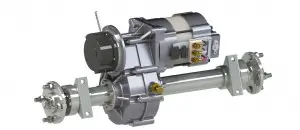
1. Why AGV Equipment Cannot Do Without a High-Quality Electric Transaxle?
- Pain Point 1: Low integration leads to unstable operation
Traditional AGVs use separate motors, reducers, and shafts. The connection between components is prone to wear and loosening after long-term use, resulting in deviations in AGV movement accuracy (such as offset during linear driving) or even sudden shutdowns. The integrated design of the electric transaxle eliminates the problem of “component mismatch” and reduces the failure rate by more than 30%.
- Pain Point 2: High energy consumption affects battery life
AGVs mostly rely on batteries for power, and the energy efficiency of the power system directly determines the working time. The transmission efficiency of traditional separate power systems is usually only 75%-80%, while the optimized gear structure and motor matching of electric transaxles can increase the transmission efficiency to 90% or more. Taking a 2-ton AGV as an example, using an electric transaxle can extend the single-charge working time by 1.5-2 hours.
- Pain Point 3: Difficult maintenance increases operating costs
When traditional power components fail, maintenance personnel need to disassemble and inspect each part separately, which takes a long time (usually 4-6 hours) and requires professional skills. The electric transaxle adopts a modular design; if a fault occurs, the entire module can be replaced in 1-2 hours, and the faulty module can be repaired offline, minimizing the downtime of AGVs.
2. Core Technical Advantages of AGV-Specific Electric Transaxles
2.1 High Torque Density: Small Size, Large Load
- Through the design of helical gears (instead of ordinary spur gears), the contact area between gears is increased by 2-3 times, which not only improves torque transmission capacity but also reduces noise (the working noise is less than 60 decibels, which is suitable for indoor quiet environments such as workshops and hospitals).
- The use of high-strength aluminum alloy housing reduces the weight of the transaxle by 20% compared with cast iron housing, while ensuring the load-bearing capacity. For example, a 30kg electric transaxle can provide a maximum torque of 500N·m, which can meet the needs of 3-ton AGVs.
2.2 High Reliability: Adapt to Long-Term Continuous Work
- The core components (motor, bearings, gears) are made of imported materials: for example, the motor uses rare earth permanent magnet materials, which have a service life of more than 10,000 hours; the bearings adopt SKF or NSK high-precision bearings, which can resist wear even under frequent start-stop conditions.
- The whole module undergoes IP65 or higher protection level treatment, which can prevent dust, water splashes, and oil stains. This is particularly important for AGVs working in harsh environments such as automobile welding workshops (with welding slag and oil mist) or cold storage (with low temperature and humidity).
2.3 High Adaptability: Match Different AGV Types
- Forklift AGVs: Need transaxles with large climbing capacity (usually ≥15°) to adapt to the height difference of the warehouse platform. The electric transaxle can be equipped with a “two-speed gearbox” to switch between “low-speed high-torque” (for climbing) and “high-speed low-torque” (for flat driving).
- Towed AGVs: Need transaxles with strong traction capacity. The electric transaxle can be customized with a “traction-enhanced motor” to pull multiple cargo carts at the same time (traction force up to 20kN).
- Miniature AGVs (for hospitals/pharmacies): Need compact transaxles (width ≤100mm) to adapt to narrow passages. The electric transaxle can be designed with a “flat structure” to fit the small body of the AGV.
2.4 High Controllability: Improve AGV Movement Accuracy
- Equipped with high-resolution encoders (up to 1024 pulses per revolution), which can real-time feedback the rotation speed and position of the transaxle to the AGV control system, ensuring that the vehicle can stop or turn accurately.
- Support CAN bus communication protocol, which can realize real-time data interaction with the AGV main controller (such as transmitting current, temperature, and fault information). The control system can adjust the output torque and speed of the transaxle in real time according to the working conditions, avoiding overload or underload.
3. Typical Application Scenarios of Electric Transaxles for AGVs
3.1 Warehouse Automated Storage and Retrieval (AS/RS)
- The electric transaxle’s high transmission efficiency reduces energy consumption, allowing the AGV to complete 200+ picking tasks on a single charge (instead of 150+ with traditional power systems).
- The low-noise design ensures that multiple AGVs can work at the same time without disturbing the warehouse environment, and the error rate of goods picking is reduced by 80% due to the high positioning accuracy.
3.2 Automotive Factory Assembly Line Material Transportation
- The electric transaxle’s high-torque design can easily carry heavy parts, and the IP67 protection level prevents oil stains and metal chips from entering the module, ensuring that the AGV can work stably in the welding workshop and painting workshop.
- The modular design reduces maintenance time: when a transaxle fails, it can be replaced in 1 hour, and the AGV can quickly return to work, avoiding the assembly line shutdown caused by long maintenance.
3.3 Port Container Automated Handling
- The electric transaxle’s housing is treated with anti-corrosion coating (such as galvanizing + powder coating), which can resist sea salt corrosion, and the high-temperature resistant motor (can work at 80℃) ensures that the transaxle does not fail in hot weather.
- The enhanced traction design allows the AGV to move smoothly on the uneven port ground, and the braking system (with electromagnetic brake) can ensure that the AGV stops stably even when carrying heavy loads, avoiding safety accidents.
4. How to Select the Right Electric Transaxle for Your AGV Project?
Step 1: Confirm the Load Requirement
- Example: If the AGV self-weight is 500kg and the maximum load is 1500kg, the total weight is 2000kg. You should choose an electric transaxle with a load capacity of ≥2400kg.
Step 2: Determine the Speed and Torque
- Tip: If the AGV needs to climb, the torque should be increased by 30% (climbing resistance needs to be considered).
Step 3: Consider the Installation Space
Step 4: Check the Environmental Adaptability
- Indoor clean environment (hospital/pharmacy): IP65 protection level, working temperature -10℃~50℃.
- Outdoor harsh environment (port/mine): IP67 or IP68 protection level, working temperature -30℃~80℃.
5. Future Trends of Electric Transaxles for AGVs: Intelligence and Electrification
- Intelligent monitoring: Equipped with temperature, vibration, and current sensors, the electric transaxle can predict faults in advance (such as gear wear, motor overheating) and send early warning information to the AGV control system, realizing “predictive maintenance”.
- Energy recovery: Adopt regenerative braking technology. When the AGV decelerates or slides downhill, the motor can be converted into a generator to charge the battery, further extending the AGV’s working time by 10%-15%.
- Lightweight and integration: Use carbon fiber materials to reduce the weight of the transaxle by 30%, and integrate the controller into the transaxle module, making the AGV’s power system more compact and reducing the overall cost of the AGV.
Conclusion: Choose the Right Electric Transaxle to Accelerate the Transformation of Intelligent Logistics
Post time: Oct-13-2025