

Electric Transaxle Factory Certification Guide: What Procurement Teams Actually Need to Verify
You can spec an electric transaxle down to the micron — gear module, continuous torque, peak efficiency, NVH target, cooling strategy — and still end up with a line-down disaster six months after launch. In our experience, the failures that hurt most rarely show up on the dimensional drawing. They show up as a certificate that looked fine in the supplier folder but meant nothing in the field, or a quality system that existed on paper for the audit week and evaporated the week after.
This guide is written for the people who actually sign off on a supplier: sourcing leads, supplier-quality engineers, and the procurement managers who have to defend a vendor choice to engineering and to finance. It is not a marketing sheet. It is a working filter — a way to read a transaxle factory’s certification package the way a buyer should, not the way a sales deck wants you to.
Why certification is the first filter, not the last
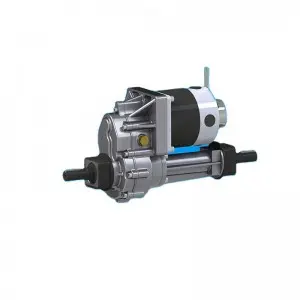
An electric transaxle (often called an e-axle) is the unit that bolts between your high-voltage source and the road. It usually packages the traction motor, the reduction gear set, and the differential into a single lubricated housing. In passenger EVs it is the heart of the drive; in industrial and off-highway vehicles — AGVs, burden carriers, utility carts, sweepers, low-speed logistics vehicles — it is the component that decides whether your machine moves, stops, and stays safe under load.
When this part fails, the consequences are rarely minor. A seized gearset strands a vehicle. A contaminated resolver signal wrecks torque control. A poorly sealed housing lets coolant into the windings. None of these are “send it back for a refund” problems; they are warranty, recall, and liability problems. That is why experienced buyers treat certification as an early qualification gate, not a box to tick at the end of the negotiation.
The trap is that certificates are easy to photograph and hard to interpret. A factory can hold a genuine ISO 9001 certificate and still ship you a part that was never validated for your duty cycle. The certificate tells you something about the system; it does not tell you the system was applied to your product. Keeping that distinction front of mind is most of the battle.
The management-system layer: what the acronyms really buy you
Before any product mark makes sense, you need to know which management-system certificates are in play. These describe how the factory runs, not what a specific unit passed.
ISO 9001 — the baseline, not the finish line
ISO 9001 is the generic quality-management standard. If a transaxle supplier does not have it, stop. It is table stakes in 2025; its absence signals either a very new operation or one that has chosen not to be scrutinized. But do not over-read it. ISO 9001 confirms there is a documented process for corrective action, traceability, and control of nonconforming product. It does not confirm the process is good, only that it exists and was reviewed by an auditor.
When we review an ISO 9001 scope statement, we read the scope line carefully. Some certificates are issued for “trading” or “assembly” only. A transaxle buyer wants the scope to cover design and manufacture of geared motor assemblies or powertrain components — not a trading-company shell that outsources the real work.
IATF 16949 — the one that matters for on-road programs
IATF 16949 is the automotive-sector quality standard built on top of ISO 9001. For any program that touches a road vehicle — even a low-speed neighborhood EV — this is the certificate that separates a serious automotive supplier from a general machinery shop. It mandates the core tools buyers rely on: APQP (advanced product quality planning), PPAP (production part approval process), FMEA, MSA, and SPC.
A practical note: IATF 16949 certificates have a defined scope and a valid until date, and they are tied to a specific manufacturing site. A group holding it at one plant does not extend it to a second plant automatically. Ask for the certificate that names the exact site shipping your parts. A “we are IATF 16949 certified” claim attached to a different legal entity is one of the most common gaps we see.
ISO 14001 and ISO 45001 — the due-diligence pair
ISO 14001 (environmental) and ISO 45001 (occupational health and safety) are not directly about product quality, but procurement teams at OEMs and tier-1s increasingly require them for their own ESG and supply-chain-risk reporting. A factory without them is not necessarily unsafe, but it is one you cannot document as compliant, and that gap can block your own customer audits.
Product compliance marks: matching the certificate to the market
Management-system certs tell you how the factory is run. Product marks tell you the unit meets regulatory thresholds for the market you sell into. Mismatching these is a classic, expensive mistake — a CE-marked part is not automatically accepted in North America, and a UL listing does not satisfy the EU Machinery Regulation.
CE marking (European Economic Area)
For transaxles destined for the EEA, CE marking is the entry ticket, and it typically draws on several directives at once:
- Machinery — the unit must meet essential health-and-safety requirements, with a technical file and, where applicable, a declaration of conformity. Note the regulation transition: the old Machinery Directive 2006/42/EC is being replaced by the Machinery Regulation (EU) 2023/1230, and buyers should confirm which framework the supplier’s documentation references.
- Low Voltage (LVD), 2014/35/EU — relevant for the motor and control interfaces above 50 V AC / 75 V DC, which most EV transaxles are.
- EMC, 2014/30/EU — the transaxle and its resolver/motor signals must not emit unacceptable interference and must tolerate it.
One thing buyers miss: CE is a supplier’s self-declaration backed by a technical file. There is no central CE registry you can query. The burden of proof sits with the manufacturer, which means your leverage is the technical file itself. Request it. If a supplier cannot produce a coherent EMC test report and a risk assessment, the CE mark on the nameplate is worth little.
ECE type approval marks (E-mark)
For on-road vehicles, two UNECE regulations come up constantly:
- ECE R10 covers electromagnetic compatibility for vehicles. It is the regulatory sibling of the EMC directive and is often what a vehicle type-approval engineer asks for.
- ECE R100 covers the safety of electric power trains, including protection against direct and indirect contact, the isolation resistance of the high-voltage system, and protection in a crash. For any transaxle carrying high-voltage busbars or integrated inverters, R100 alignment is not optional if the vehicle must be type-approved.
North America: UL and ETL
In the US and Canada, the accepted route is a third-party listing from a Nationally Recognized Testing Laboratory — UL is the familiar name, ETL (Intertek) the common alternative. For motors and driven assemblies, standards such as UL 1004 (rotating electrical machines) and relevant electrical-safety clauses apply. The key word is listing, not a component recognition buried in a test summary. A buyer should confirm the listing covers the assembled transaxle configuration you are buying, including any integrated controller, not just the bare motor.
Material restrictions: RoHS and REACH
RoHS (restriction of hazardous substances) and REACH (registration, evaluation, authorization of chemicals) are frequently assumed and rarely verified. For a transaxle, the practical risks are in the potting compounds, the wiring harness, the plating on connectors, and the grease. Request a material declaration with declared substance concentrations. If a supplier hands you a one-line “compliant” email instead of a substance table, that is a data gap you will be asked to close during your own customer audit.
Functional safety and reliability: the deeper layer most buyers skip
Once the regulatory marks are in place, the next tier is about whether the unit behaves safely when something goes wrong — and whether it survives your real duty cycle.
ISO 26262 and the ASIL question
ISO 26262 is the automotive functional-safety standard. It is not a certificate you “have”; it is an argument, supported by a safety case, that the product meets a target Automotive Safety Integrity Level (ASIL). For a transaxle with an integrated inverter and torque control, functional safety is genuinely in scope: loss of torque command, unintended movement, or failure to provide braking regeneration are all safety-relevant.
Be realistic. A small industrial transaxle for a 10 km/h warehouse tug may not need an ASIL-rated safety case at all, and demanding one will inflate cost and lead time for no benefit. The buyer’s job is to map the application’s safety requirement to the right level — and to refuse suppliers who claim “full ISO 26262 compliance” without being able to name the ASIL and show the corresponding work products.
Validation evidence: PPAP, DV, PV
Regardless of standard, insist on validation packages:
- Design Validation (DV) — does the design meet the spec across temperature, vibration, ingress, and endurance?
- Production Validation (PV) — do parts coming off the actual production line and tooling meet that same spec?
- PPAP — the IATF documentation bundle (control plan, process flow, MSA, capability studies) that proves the process is under control.
A supplier that shows you a shiny DV report from three years ago, on a different customer’s variant, has not validated your part. The part number, revision, and test configuration in the report must match what you are buying.
Ingress, environment, and the IP rating trap
IP ratings are quoted constantly and understood rarely. IP67 means immersion protection to 1 meter for 30 minutes — it is not a pressure-wash rating. IP6K9K (often required for underbody automotive parts) is the high-pressure, high-temperature wash rating. For off-highway and cleaning-equipment transaxles, the difference is the difference between a unit that survives a floor-scrubber’s daily washdown and one that fills with detergent. Ask which test method was used and request the lab report, because “IP67″ stamped on a drawing with no test backing is a hope, not a rating.
How to verify a certificate is real (the part sales decks hate)
Holding a PDF is not the same as holding proof. A few moves separate a verified supplier from a convincing one:
- Match the certificate number to the issuing body’s database. Major notified bodies and registrars — TÜV SÜD, TÜV Rheinland, DEKRA, SGS, Bureau Veritas, DNV, and others — publish certificate verification portals. A real IATF 16949 or ISO certificate can be checked by number. If the registrar is obscure or the number does not resolve, treat it as unverified.
- Confirm the legal entity and site address. Certificates name a legal entity and a manufacturing address. The entity on the certificate should be the entity on your purchase order and the entity operating the plant you visit.
- Check the scope and the expiry. A certificate valid for “distribution” does not cover manufacture. One expiring in 60 days needs a renewal plan before you commit volume.
- Request the underlying test report, not just the mark. CE, EMC, IP, and RoHS all rest on test data. The report should name your product family, the standard, the test house, and a date.
- Do a live remote or on-site audit of the documented process. Watch the factory pull a corrective-action record, a calibration log, and a traceability record in real time. If the quality engineer has to “find that later,” the system is not live.
Certification requirements by application segment
The right certification stack depends entirely on where the transaxle ends up. Below is a practical mapping we use when qualifying suppliers for different programs.
| Application | Management system | Product / regulatory | Functional safety | What we would not waive |
|---|---|---|---|---|
| Passenger / on-road EV | IATF 16949 | CE (LVD, EMC, Machinery), ECE R10, ECE R100 | ISO 26262 safety case at the required ASIL | R100 alignment, PPAP, DV/PV with your part number |
| Low-speed / neighborhood EV | IATF 16949 or strong ISO 9001 with APQP | CE or regional equivalent; EMC | Risk assessment, basic safety concept | EMC evidence, ingress rating for the duty cycle |
| Industrial / AGV / warehouse | ISO 9001 + documented APQP | CE Machinery where required; UL/ETL for North America | ISO 13849 for safety-related control where applicable | IP rating matched to washdown, endurance test data |
| Off-highway / utility / cleaning | ISO 9001 | CE Machinery; regional marks per market | Application-specific risk assessment | IP6K9K where washed; thermal and load endurance |
| Marine / specialty | ISO 9001, often ISO 14001 | Market-specific marks; corrosion validation | Environment-driven safety review | Corrosion and salt-spray evidence, sealed electronics |
Notice the pattern: as you move from on-road to industrial to specialty, the regulatory weight shifts from type-approval marks to environmental and endurance evidence. The buyer who demands a full automotive stack for a floor-cleaning transaxle will pay for paperwork they cannot use; the buyer who accepts “ISO 9001 is enough” for a road vehicle will be explaining a recall to a regulator.
Red flags that show up before you ever visit the plant
Most disqualifying signals appear in the document exchange, long before a factory tour. Watch for these:
- Certificate scope does not match the product. ”Trading” or “sales” scope on a quality cert for a manufacturing job.
- One certificate covering many unrelated legal entities. Group certificates exist, but each site still needs its own scope evidence.
- Test reports with the customer name blanked out or a different part number. This is evidence borrowed from someone else’s program.
- Reluctance to share the technical file or material declaration. If they cannot show compliance data, they likely do not have it.
- Audit findings described as “all closed” with no corrective-action records. Perfect audits are not credible; mature systems show how they found and fixed problems.
- Pressure to skip PPAP “because we’ve done this a thousand times.” Volume is exactly why the process exists.
Building a supplier scorecard you can defend
Certification data is only useful if it feeds a decision. We recommend a simple weighted scorecard so the conversation with engineering and finance stays objective. A starting template:
| Criterion | Weight | Pass threshold | Evidence to collect |
|---|---|---|---|
| Quality system (IATF/ISO scope) | 25% | Correct scope, valid, verifiable | Certificate + registrar check |
| Product compliance marks | 25% | Marks match target markets | Test reports, declarations |
| Validation (DV/PV/PPAP) | 20% | Reports match your part/revision | PPAP package, test logs |
| Functional safety fit | 15% | Aligned to application risk | Safety concept or ASIL case |
| Traceability & audit access | 15% | Live records on request | Remote audit, sample pull |
The weights should shift with the program. A road-vehicle launch pushes functional safety and PPAP to the top; an internal-material-handling fleet purchase can lean on environmental evidence and delivery reliability. The point is not the exact percentages — it is that the choice is documented and repeatable, so a different buyer six months later reaches the same conclusion from the same evidence.
A pre-award audit checklist
Before issuing a purchase order for production volume, walk this list with the supplier on a live call or on site:
- Certificate numbers for ISO 9001 / IATF 16949, with registrar and expiry — verified in the portal.
- Scope line confirms design and manufacture of the relevant component class.
- CE / E-mark / UL-ETL documentation set, with underlying test reports naming the product family.
- RoHS and REACH declarations with substance-level data, not blanket statements.
- DV and PV reports for the exact part number and revision you will buy.
- PPAP level agreed (typically Level 3 for production parts) with a submission date.
- Functional-safety positioning: required ASIL or documented “not safety-related” justification.
- Ingress rating evidence (IP67 vs IP6K9K) matched to the operating environment.
- Traceability demo: can they pull a unit’s build record and component lots on the spot?
- Corrective-action demo: show the last three CAPAs and their closure evidence.
If a supplier clears this list with real, matching documents, you have a defensible vendor. If they clear it only after three follow-up emails and a “we’ll send it next week,” the hesitation itself is the answer.
The pragmatic bottom line
Certification for an electric transaxle is not a trophy wall. It is a risk-control system, and like any system it is only as strong as the evidence behind it and the discipline with which you check it. The buyers who get burned are rarely the ones who missed a standard — they are the ones who accepted a certificate as proof instead of as a pointer to proof.
Read the scope, match the mark to the market, demand the test report behind the logo, and verify the number in the registrar’s database. Build the scorecard so the decision survives scrutiny. Do that consistently, and the transaxle that shows up at your dock will be the one that was actually qualified — not the one that was merely photographed.
For procurement teams building a qualified-supplier list, the work is unglamorous but predictable: a clean certificate folder, a live process behind it, and a checklist you actually use. Get those three right and most of the nasty surprises disappear before they ever reach your line.
Post time: Sep-04-2026