

Electric Transaxle MOQ Explained for Buyers
When sourcing electric transaxles for electric vehicles, utility carts, industrial sweepers, or mobile machinery, Minimum Order Quantity (MOQ) is one of the most critical terms you’ll negotiate. It directly impacts your upfront costs, inventory risk, production flexibility, and long-term supplier partnership. This guide breaks down everything buyers need to know about electric transaxle MOQs—what they are, what drives them, how they vary by product type, and how to negotiate terms that fit your business.
Table of Contents
- What Is Electric Transaxle MOQ?
- Key Factors That Determine Electric Transaxle MOQ
- Typical MOQ Ranges for Common Electric Transaxle Models
- How MOQ Affects Your Total Cost of Ownership
- Practical Strategies to Negotiate Flexible MOQ
- MOQ vs. Lead Time: Balancing Key Purchase Terms
- FAQs About Electric Transaxle MOQ
- Conclusion
What Is Electric Transaxle MOQ?
MOQ stands for Minimum Order Quantity—the smallest number of units a manufacturer will accept for a single production run of a specific electric transaxle model. Suppliers set MOQs to cover setup costs, material procurement, production line efficiency, and quality control.
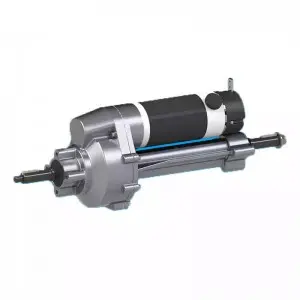
For electric transaxles—integrated assemblies of motor, gearbox, differential, and output shafts—MOQs reflect the complexity of component matching, precision machining, and end-of-line testing. Ordering below the MOQ often results in higher unit costs, delayed production, or order refusal.
Key Factors That Determine Electric Transaxle MOQ
Several variables shape the MOQ for any electric transaxle model. Understanding these helps you set realistic expectations and negotiate smarter.
1. Product Customization Level
- Standard off-the-shelf models: Lower MOQs, as parts are pre-procured and production lines are pre-configured.
- Custom voltage, power, ratio, or shaft size: Higher MOQs, as they require special tooling, modified components, and separate testing.
- Branded housing, cable length, or connector type: Usually adds a MOQ floor to justify customization labor.
2. Production Setup Costs
Electric transaxle production involves:
- Gear cutting and heat treatment
- Motor winding and impregnation
- Assembly line calibration
- Performance and durability testing
Small runs spread these fixed costs over fewer units, forcing suppliers to set a minimum volume to maintain profitability.
3. Component Supply Chain Constraints
Key parts such as DC motors, encoders, brakes, and gear sets often come in bulk batches. Suppliers must meet their own vendors’ MOQs to secure stable pricing and lead times, which they pass along to buyers.
4. Quality & Certification Requirements
Electric transaxles used in commercial and industrial equipment often require consistent performance and safety checks. Mass production improves uniformity and reduces per-unit quality costs. Strict quality standards typically correlate with higher MOQs.
5. Order Frequency & Long-Term Partnership
Suppliers often lower MOQs for:
- Repeat buyers with predictable demand
- Clients willing to commit to annual volume contracts
- Partners that combine multiple models into consolidated orders
Typical MOQ Ranges for Common Electric Transaxle Models
MOQs vary widely based on power rating, application, and customization. Below are realistic ranges for mainstream products.
| Transaxle Type | Typical Power | Common Applications | Standard MOQ Range |
|---|---|---|---|
| Light-duty electric transaxle | 300W–800W | Furniture movers, golf carts, sweepers | 100–300 units |
| Medium-duty electric transaxle | 1000W–1500W | Industrial trolleys, electric tractors | 200–500 units |
| Heavy-duty electric transaxle | 2000W+ | Heavy-duty utility vehicles, carriers | 300–800 units |
| Customized integrated transaxle | Custom specs | Special-purpose EV platforms | 500–1000+ units |
Note: These are general benchmarks. Actual MOQs may vary by manufacturer, material availability, and seasonal demand.
How MOQ Affects Your Total Cost of Ownership
A low MOQ isn’t always better. Buyers must balance order size against real total costs:
1. Unit Price
Higher order volumes usually lower per-unit cost due to economies of scale in materials, labor, and overhead.
2. Inventory Holding Cost
Excess inventory ties up working capital and requires storage. A too-high MOQ can increase depreciation and obsolescence risk.
3. Logistics & Shipping Cost
Consolidating orders reduces shipping cost per unit. Small-batch shipments often have less favorable freight terms.
4. Production Stability
Meeting MOQs helps suppliers maintain smooth scheduling, which improves on-time delivery rate and product consistency.
Practical Strategies to Negotiate Flexible MOQ
You don’t have to accept the first MOQ a supplier offers. Use these proven tactics to gain flexibility.
1. Start with Standard Models
Avoid over-customization early. Use standard voltage, ratio, and shaft options to qualify for lower MOQs. Modify later once demand is validated.
2. Combine Multiple Models in One Order
Mix light-duty and medium-duty transaxles in a single purchase to reach a collective volume threshold. Most suppliers accept mixed-model orders to hit MOQ.
3. Commit to Forecast or Annual Volume
Share a 6–12 month demand forecast. Many suppliers will cut MOQs in exchange for a confirmed annual purchase intent.
4. Accept Longer Lead Times
Suppliers can fit small orders into spare production slots if you agree to extended lead times. This lowers their opportunity cost and your MOQ.
5. Request a Trial Batch
Ask for a small pilot order (e.g., 50–100 units) at a slightly higher unit price to test performance before full-scale launch.
6. Build Long-Term Alignment
Communicate your roadmap, new projects, and scaling plan. Suppliers prioritize loyal partners with more favorable terms, including flexible MOQs.
MOQ vs. Lead Time: Balancing Key Purchase Terms
MOQ and lead time are closely linked. Use this framework to optimize both:
- Low MOQ + Short lead time: Highest cost per unit; best for prototypes and small-batch trials.
- Standard MOQ + Moderate lead time: Best balance for regular production; ideal for most buyers.
- High MOQ + Long lead time: Lowest unit cost; suitable for mass production and stable demand.
Always clarify:
- Can we adjust MOQ if we extend lead time?
- What is the lead time for MOQ orders vs. full-container orders?
- Are there penalties for changing order volume after confirmation?
FAQs About Electric Transaxle MOQ
What is a reasonable MOQ for a first-time buyer?
For first orders, 100–300 units for standard light-duty models and 200–500 units for medium-duty models are reasonable. Focus on proven models to minimize risk
Can I get a lower MOQ if I pay a higher unit price?
Yes. Many suppliers accept small-run orders at a premium unit price to support new clients and trials.
How long does it take to produce MOQ orders?
Standard lead times for MOQ orders range from 15–35 days, depending on model availability and component stock.
Do MOQs include customized accessories like brakes or encoders?
Usually not. Add-on features often have separate MOQs or increase the base MOQ. Clarify this during quotation.
Can I split a MOQ order into multiple shipments?
Many suppliers accept partial shipments to help you manage inventory. Confirm scheduling and logistics costs upfront.
Conclusion
Understanding electric transaxle MOQ helps you make better sourcing decisions, control costs, and build stronger supplier relationships. MOQ isn’t just a number—it’s a reflection of production economics, component supply, and quality stability.
Post time: May-06-2026